Where the Money Is in Preconfiguration: Fewer Failed Agent Sessions and Control Over Every Agent Machine
Preconfiguration is a prototype today, so its business case is a plan to test with customers. Nobody pays for the translation step by itself: compilers like this are cheap to write, and the engine that writes each platform’s file should be free, as most developer tools are. The money comes from teams that run several agents across many repositories, paying for fewer failed sessions, one view of every repository’s agent setup, and control over what agent machines install. Prebuilt machines, so sessions skip the install, come after that. None of it has been priced with a buyer yet.
Agent time is now metered. GitHub moved Copilot to usage-based billing on June 1, 2026, and a Copilot cloud agent session uses GitHub Actions minutes and AI credits. Setup runs inside that paid session, so every minute of failed or repeated setup is billed. And the pool is large: JetBrains’ 2026 survey of more than 15,000 professional developers found 90% using AI coding agents at work at least weekly, and 68% daily.
One Setup File per Vendor Is the Gap
A typical engineering team in 2026 doesn’t use one agent. In The Pragmatic Engineer’s 2026 survey, 70% of engineers used two to four AI tools and 15% used five or more. Each agent platform reads its own setup file, in its own format, with its own silent failures. A platform team looking after a hundred repositories can’t answer the questions that matter: which repositories are set up for which agents, which setups still work, and what the agents’ machines install.
That’s the product Preconfiguration would sell. One spec per repository, compiled for every platform, checked on every change and proven on a clean machine, with a view across all of them. Companies already buy this shape of product elsewhere: one tool that keeps dependencies current across every repository, one that scans them all for secrets. Agent setup is the same kind of chore, repeated per repository and per platform, and it grows with every agent a team adds.
Who Pays, and for What
| Buyer | The problem | What they’d pay for | How it’s priced |
|---|---|---|---|
| Platform and developer-experience teams | Many repositories, several agents, setups that drift and fail silently | One view of every repository’s agent setup, drift alerts, checks on every pull request | Per developer, per month |
| Security and compliance teams | No say over what agent machines install, or from where | Rules on package sources and versions, an audit trail of every setup | Part of an enterprise plan |
| Teams paying per agent session | Minutes of setup in every session | Hosted checks, and prebuilt machines so sessions skip the install | By usage |
| Sandbox and agent platforms | Customers’ environments described in a dozen formats | A neutral spec their platform can load | A partnership, or a license |
A Price List to Test
None of these prices has been tried on a buyer yet. They’re starting points for conversations with teams during the Beta.
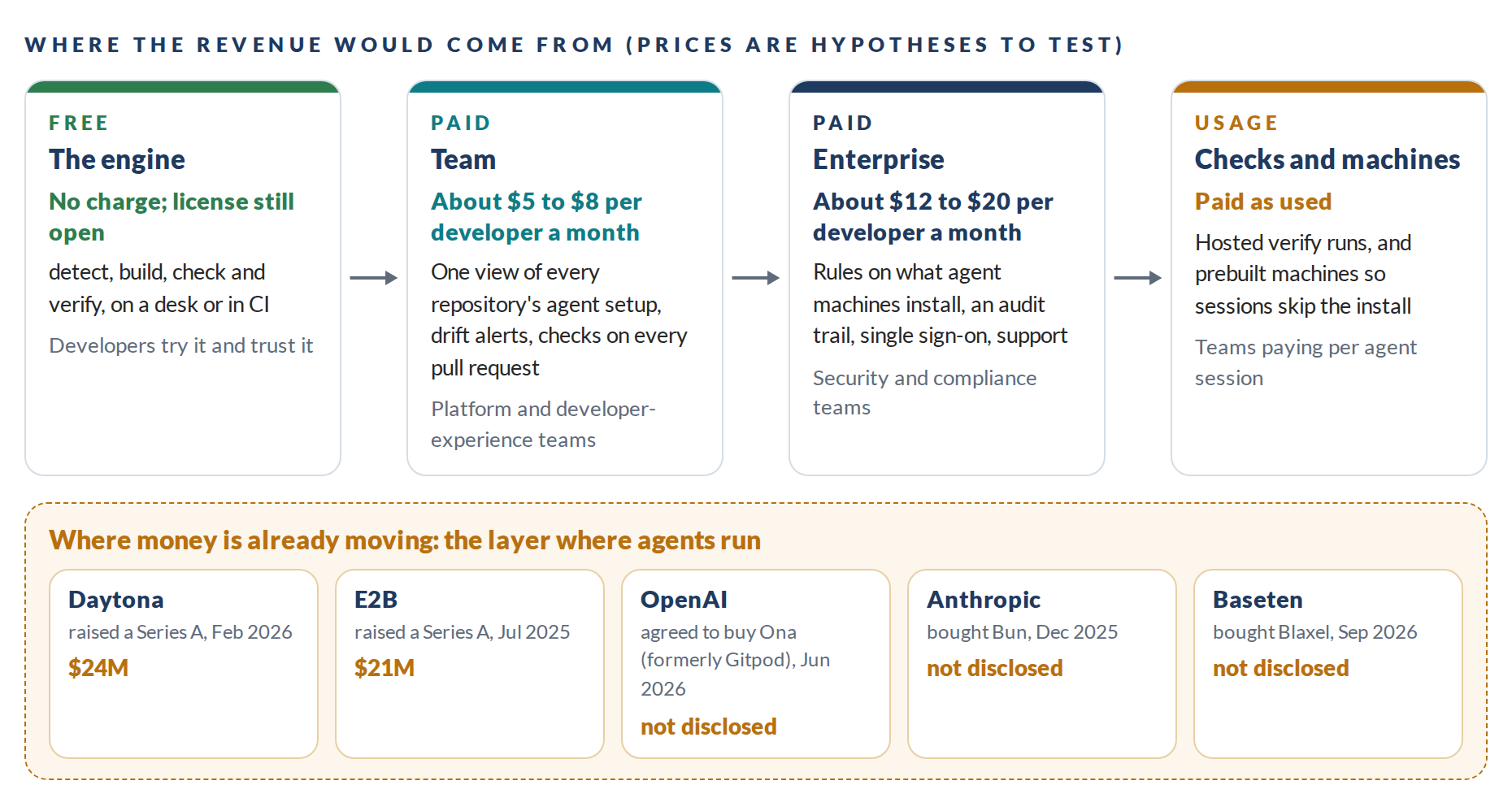
- The engine, free. detect, build, check and verify on a developer’s machine and in CI. The license is still to be chosen, but trying preconfig should cost nothing either way.
- Team, about $5 to $8 per developer a month. One view of every repository’s agent setup, drift alerts, and a check on every pull request that touches the setup.
- Enterprise, about $12 to $20 per developer a month. Rules on what agent machines may install and from where, an audit trail, single sign-on and support.
- Usage. Hosted verify runs, and prebuilt machines for each spec, paid for as used.
The anchor is the agent itself. Copilot Business costs $19 per user a month and Copilot Enterprise $39, each including that much in monthly AI credits. A tool that makes those seats work on more repositories, and wastes fewer of their sessions, should cost a fraction of a seat. Pricing the Team plan at about a third of a Copilot Business seat is a first guess to test.
Rough Arithmetic
Rough numbers only, with the Team plan at $6 per developer a month:
| Paying customers | Developers each | Revenue a year |
|---|---|---|
| 20 early teams | 50 | $72,000 |
| 100 companies | 100 | $720,000 |
| 500 companies | 200 | $7.2 million |
Enterprise seats and usage come on top. The table is about scale: a few hundred paying companies would make this a real software business, and the usage line could grow faster than the seats if prebuilt machines save real minutes in every session.
Where Money Is Already Moving
The layer where agents run is attracting money. Daytona raised a $24 million Series A in February 2026 to give agents their own sandboxed computers, and E2B raised $21 million in July 2025 for the same kind of cloud. And the companies building agents have been buying the infrastructure under them:
| Acquirer | Company | What it does | Announced |
|---|---|---|---|
| Anthropic | Bun | The JavaScript runtime that powers Claude Code | December 2025 |
| OpenAI | Ona, formerly Gitpod | Cloud environments where Codex agents keep working, in the customer’s own cloud | June 2026 |
| Baseten | Blaxel | Sandboxes for AI agents, each in its own small virtual machine | September 2026 |
None of these prices was disclosed. Two things stand out. The companies that run agents are investing in the machines under them, the layer a neutral setup spec serves. And environments are part of what they bought: Ona’s product is the environment an agent works in.
What Could Stop the Money
- The platforms converge. If every agent platform settles on one setup format, translating matters less. Checking and proving would still matter, but the pitch gets narrower.
- Agents set themselves up. Cursor can already set up a cloud environment with a guided agent, and others will follow. A reviewed spec has to stay more reliable than an agent’s guess, and the Beta measures whether it is.
- The compiler is easy to copy. Converters like this are cheap to write. agnostic-ai, which writes AI tools’ instructions from one source, has written environment files since at least early September 2026, starting with Cursor’s cloud agent environment. The value has to live in checking, proving and the team layer, not in the translation.
- Platform teams build it in-house. Many already keep a shared setup script and call it from each agent’s file. The product has to be clearly better than that script, and cheaper than maintaining it.
- Willingness to pay is untested. A team may happily use the free engine and never pay for the rest. That is the first thing the Beta asks.
What the Beta Has to Prove
The Beta runs about 12 weeks, and it’s where the business case gets its first real numbers:
- Every target runs on its own platform for real repositories, and generated setups fail less often than hand-written ones.
- Teams’ agents work for four weeks on generated setups, with setup minutes and failed sessions measured against their old setups.
- At least a few teams say what they would pay for the team features, and the Team price survives those conversations or gets corrected by them.
If those hold, there are two ways forward: raise a seed round to build the team layer and hosted checks, or license the spec and the engine to the agent and sandbox platforms that need their customers’ environments described.