What Sets Preconfiguration Apart: The Machine Layer, Checked and Proven, Across Every Agent Platform
The code that turns one spec into five files won’t set Preconfiguration apart. Converters like it are cheap to write, and others are close. What can is the layer it owns, the proof it gives, and four defenses that are slow to build.
The Layer It Owns
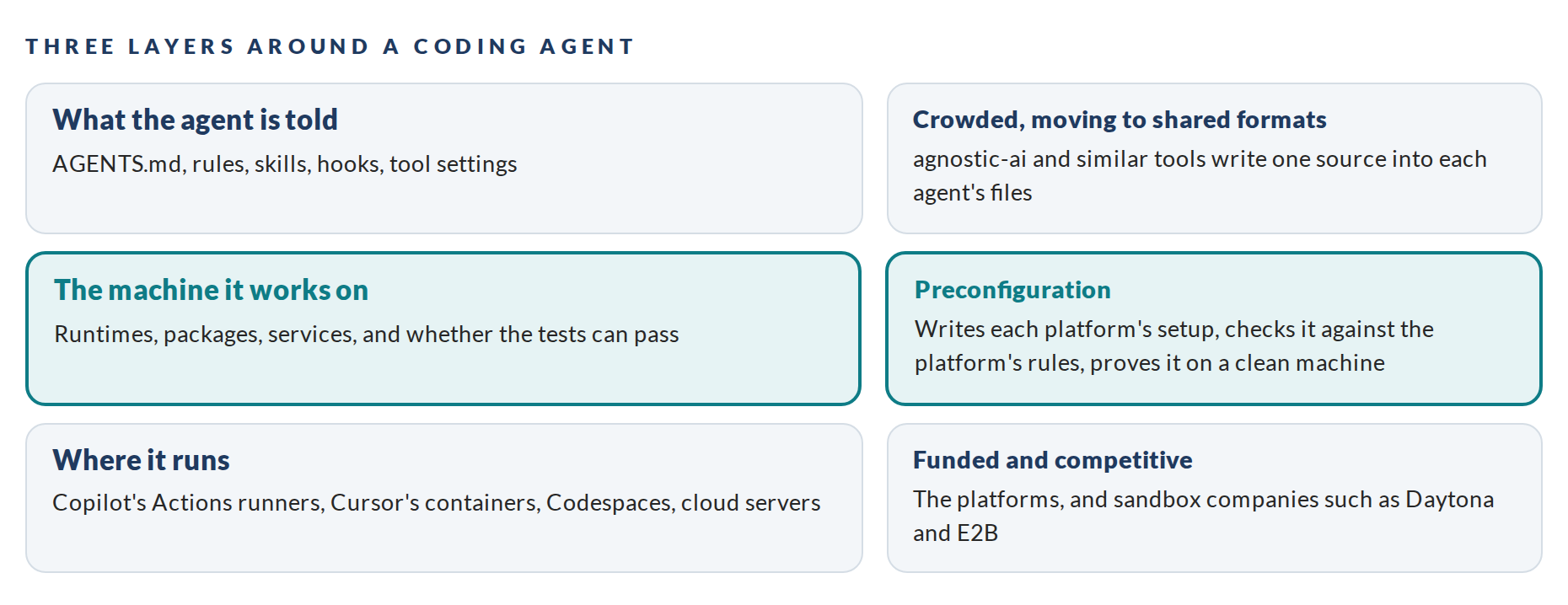
A coding agent’s world has three layers. On top is what it’s told: AGENTS.md, rules, skills, tool settings. At the bottom is where it runs: a GitHub Actions runner, Cursor’s containers, a sandbox company’s virtual machines. In between is the machine itself: which runtimes are installed, which packages, which services are running, and whether the tests can pass there.
The top layer is crowded, and moving fast toward a shared format. The bottom layer is funded and competitive. The middle layer is mostly hand-written files, one per platform, that nobody tests, though instruction tools have started to reach into it: agnostic-ai writes Cursor’s environment file. That’s the layer Preconfiguration takes, and only that layer.
Against the Nearby Options
| Nearby option | What it does | Where Preconfiguration differs |
|---|---|---|
| agnostic-ai and similar tools | One source of rules, skills, agents, hooks and MCP settings, written into each agent’s files; environment files too, Cursor’s since early September 2026 and Claude Code’s and Codex’s since late September | Owns the machine layer, runtimes, packages and services, with each platform’s own rules checked and a ready check that proves the result |
| Devbox and other environment managers | Development environments from Nix packages, which can also write a devcontainer.json and a Dockerfile | Writes each platform’s native file and leaves; nothing of its own to install on the agent’s machine |
| devcontainer.json alone | The open standard for container setups | One target among five; Copilot’s cloud agent runs its own workflow, apart from the dev container |
| Each vendor’s own setup help | Cursor can set up a cloud environment with a guided agent | Works across vendors, with one file a person can review |
| A hand-written setup script | One script, called from each agent’s file | Writes those files, checks them and runs the script on a clean machine |
Two differences run through the table. Proof: none of the nearby options runs the setup on a clean machine with the project’s own tests and says which step broke. Checking what exists: none reads the setup files a repository already has against each platform’s rules, where most of the silent failures live.
What Would Be Hard to Copy
Ranked, strongest first:
- A format others adopt. AGENTS.md shows how fast a plain file can become a standard: released in August 2025, used by more than 60,000 open-source projects, then handed to the Linux Foundation that December. A
preconfig.yamlspec could aim to be that for agents’ machines. The spec can be open while the engine stays proprietary; that choice is part of the license decision still to come. - Format knowledge that compounds. A dated record of every platform’s setup format, every rule that isn’t in a schema, and every change to them. It’s small, dull to maintain and easy to get wrong, which is why few will copy it well. The Alpha’s knowledge base is the start of that record, dated September 29, 2026.
- Test data, if checks are hosted. Which stacks break on which platforms, and what fixed them. It only exists if people run checks through the service, and then it grows with every run.
- Integrations. A GitHub Action that checks every pull request, and sandbox and agent platforms that load
preconfig.yamldirectly. Each one makes the spec more useful and moving away from it more costly.
What Isn’t a Moat
The compiler code isn’t. It’s 1,071 lines of Go for five targets, and a competent team could write its own in weeks. Neither is being first: agnostic-ai has written Cursor’s environment file since at least early September 2026, and platforms’ own agents are learning to set themselves up. Speed matters for that reason. The project has to get to the four defenses above while the middle layer is still unclaimed.
What to Watch
- Instruction tools moving down a layer. agnostic-ai and tools like it adding cloud agent targets, checks and proof.
- The platforms converging. If every agent platform settles on one setup format, translation matters less, and the case rests on checking, proving and the team layer.
- Agents that set themselves up well. If platforms’ own agents get reliable at setup, a reviewed spec has to stay more reliable than their guess. The Beta compares the two on real repositories.
Where It Stands
The Alpha shows the layer can be owned: five targets from one spec, each checked against its platform’s rules, and the setup proven on a clean machine. What it doesn’t show yet is any of the four defenses: no one else uses the format, the knowledge base is new, no checks are hosted and no integration exists. Building those is what the roadmap is for.